Lei Liang’s music pairs with pinot
Originally Published in Classical Voice North America August 2026
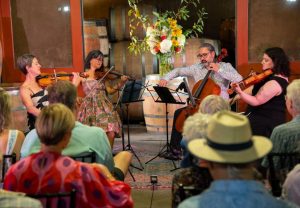
WILLAMETTE VALLEY, Ore. — Sipping Oregon wines while listening to exquisitely performed chamber music in barrel rooms, wine cellars, and tasting rooms is the art and soul of the Willamette Valley Chamber Music Festival. Three glasses of wine — well, half-glasses — poured before and during the weekend concerts come with admission.
Founded in 2015 by violinist and onetime Oregonian Sasha Callahan, who occasionally pines for Mt. Hood, and husband-cellist-oenophile Leo Eguchi, along with strategic guidance from Sasha’s sister, Portland arts leader Eve Callahan, the couple returns to Oregon wine country every summer from Boston, where they teach and perform with the Sheffield Players, among other chamber groups and orchestras.
When not performing, part of their mission is to respond to under-served audiences. They volunteer in Oregon’s wine country with the Junior Orchestra of Yamhill (JOY), bringing their knowledge to kids interested in knowing more about classical music. They put on a free family concert series at the Tualatin Public Library on Friday mornings.
And they hire primarily underplayed and BIPOC (Black Indigenous and People of Color) musicians — many of whom are rising-star artists — as their composers-in-residence. This year, Chinese-American Lei Liang, a finalist for the Pulitzer Prize in Music in 2015 for Xiaoxiang for alto saxophone and orchestra, was their pick. Former composers whose work was featured in the festival and has been played in other WVCMF concerts include Jessie Montgomery, 2026 Pulitzer Prize winner Gabriela Lena Frank, Osvoldo Golijov, Joan Tower, Reena Esmail, Kareem Roustom, Kevin Day, Kenji Bunch, Daniel Bernard Roumain, and Akshaya Avril Tucker.
With a composer in place, Callahan and Eguchi gather several fellow string artists, most from Oregon, and, in late July, taste and test vintages from hosting wineries to “match” or complement the pieces they’ve chosen for three programs on three consecutive weekends.
Concerts take place at J. Christopher at Appassionata Estate, Archery Summit, and Sokol Blosser Winery, each about an hour from Portland via car. J. Christopher’s wine cellar holds about 90 concertgoers; Archery Summit and Sokol Blosser accommodate 45-50 ticketholders.
This year’s festival, Aug. 8-23, explores the theme “Inventing America,” as the country celebrates its 250th birthday of innovation, rebellion, individuality, and freedom. Along with the dominant American component, the 2026 even also features music from such familiar favorites as Mozart, Beethoven, and Dvořák.
On opening night, Aug. 8, two of Liang’s pieces were mixed in with Beethoven’s sunny String Quartet G major, Op. 18, No. 2, performed exuberantly, and Esmail’s This Is It, Part 3, a fast-moving piece with four miniatures entitled “Conform/Diverge,” “Extend/Retract,” “Entwine/Enfold,” and “Swirl/Whirl.” The miniatures celebrate the present — being in the moment — inspired by Jon Kabat-Zinn’s book on meditation, Wherever You Go, There You Are. Esmail, who has northern Indian roots, was born, raised, and educated in the United States and is better known for her choral works than for her chamber music. Still, the musicians made sense of this work, a section of a larger suite. Callahan and Eguchi, along with violinist Megumi Stohs Lewis and violist Wendy Richman made the string quartet come alive despite its tricky rhythms and idiosyncratic transitions.
The evening’s big moments, however, were visiting-composer Liang’s two pieces. The first, Gobi Gloria, was inspired by Mongolian long song and Inner Mongolia’s vast landscape. Liang, 53, an energetic, voluble, and enthusiastic professor of composition at the University of California, San Diego, told the audience before the musicians got to work that Gobi Gloria was inspired by his mentor, the Mongolian musician and scholar Wulalji. When Liang was growing up in Beijing, Wulalji taught him Mongolian long song. A friend of his parents, Wulalji and Liang’s family traveled together in Inner Mongolia, “and those experiences changed my life,” said Liang, who came to the United States at 17 as a high school student, graduated from New England Conservatory of Music, and earned a Ph.D. at Harvard University.
At one point, Liang heard Wulalji improvising with a throat singer as they brought together two love songs over a “drone” sound. “There was something magical about that moment, and it stayed with me for nearly 20 years,” Liang said.
Eventually, he said, the long song sonic world found its way into Gobi Gloria, a piece that expresses loneliness and longing amid the sounds of the landscape. Having grown up in China at the end of the Cultural Revolution, Liang was inundated with propaganda music that was upbeat and shallow, celebrating the so-called happy life on farms and communes. “That is probably why I don’t write happy music,” Liang said, adding, tongue-in-cheek, that “the right way to play this music is to be slightly drunk.” The Mongols drank a lot when they weren’t conquering lands.
Gobi Gloria starts with a melancholy love song initiated by violinist Stohs Lewis and is gradually filled out by the three other musicians’ strings. The ending sounds like horses galloping across the boundless Mongolian landscape. The music is mesmerizing.
Eguchi matched Esmail’s piece and Gobi Gloria with the Appassionata 2023 Uber Sauvignon Blanc, explaining that “we love the way this wine pairs with Esmail’s contrasting and richly colorful miniatures by showing a kaleidoscope of lemongrass, citrus peel, toasted coconut, gooseberry, and grapefruit. This Sauvignon Blanc also has a fascinating texture with an incredibly long citrusy finish, unfolding slowly like a tune carried across the wide windswept expanses evoked in Lei Liang’s Gobi Gloria.”
Liang’s final piece, Six Seasons, drove a number of people out of the wine cellar, perhaps not unlike Stravinsky’s Le Sacre du printemps at the initial 1913 Paris performance, which drew boos and hisses. Six Seasons was produced in part by Liang’s “Lei Lab” at UC San Diego. The lab is his undertaking with engineers, geologists, oceanographers, and software developers to collaborate and create music and immersive art through “creative listening” — which means, in part, finding and understanding natural sounds, many not available to human ears. His TED Talk about Lei Lab further explains the concept.
Two of Six Seasons’ six movements, “Darkness” and “Migration,” made up the 15-minute piece we heard. Played in its entirety, Six Seasons is 60-80 minutes long. Liang orders the seasons: “New Ice,” “Darkness,” “Sunrise, ” “Migration,” “Cacophony,” and “Bloom.” He likes to break up the seasons for various concerts, and in this case two seasons were plenty for much of the audience.
The piece begins with a recording of the breaking Arctic ice from the ocean floor (sounding a bit like fingernails scratching a blackboard), then segues to sounds of bearded seals showing off their voices for potential lovers and mates. It ends with the mournful cry of a stranded Beluga whale.
What do the musicians do, meanwhile? Liang has a “living score,” rather than notation. “Just as ice serves as a ‘living score’ that the Inuit set their lives to, the musicians’ role is as much about listening as it is about responding creatively to these prerecorded sounds with their instruments. The performers are therefore indispensable collaborators in shaping and realizing the piece,” he explained in a post-concert email.
So we heard plucking, thumping, strumming, bowing, and just about any sound a string musician can produce with an instrument. Musicians left their seats and moved around the cellar. Each performance is different, and in this piece, classical musicians are improvising and composing, in a sense, along with Liang.
Six Seasons is named after the Inuit calendar. “In the Arctic, the six seasons are not defined by fixed dates on a calendar, but by changes and patterns in the environment — many of which we can hear,” Liang said in an email after the concert. For more about Six Seasons, go here.
What about the Six Seasons’ wine? Each year, Eguchi, Callahan, and the J. Christopher/Appassionata winemaking team choose a wine to commemorate the composer-in-residence. The winery bottles it with a new label — this time a piece of art from Liang’s 17-year-old son, Albert, created on canvas with acrylics when he was two. The result was J. Christopher Six Seasons Special Commemorative Bottling, 2023 Pinot Noir, La Colina Vineyard.
“Lei Liang has a beautiful talent of asking the listener to explore richness and beauty that might be lying just beneath the surface of the natural world,” said Eguchi.
The weekend of Aug. 15–16, in Archery Summit’s barrel room, listeners will hear Liang’s interpretation for contemporary string quartet of Claudio Monteverdi’s 17th-century madrigal “Lamento della Ninfa.” Liang’s work will be featured with Mozart’s Sring Quartet in C major, K. 465 (Dissonance) and former festival two-time composer-in-residence Montgomery’s Source Code, a single-movement composition structured to reflect African-American spirituals. The program also includes the West Coast premiere of Kian Ravaei’s wildly original Neverland.
Musicians joining Eguchi and Callahan for the second and third weekends will be violist Charles Noble and violinist Greg Ewer, both Oregon Symphony Orchestra members.
The final weekend, Aug. 22–23 at Sokol Blosser Winery in Dayton, Ore., will spotlight Indigenous traditions. Pieces include Dvořák’s String Quartet in F major, Op. 96 (American), written in 1893 in Spillville, Iowa, when he was captivated by American music, including that of Black and Indigenous communities; Tuscarora/Taino singer-songwriter Pura Fé’s traditional Rattle Songs, originally on the 1997 album with her a cappella group Ulali, and later orchestrated for string quartet by Chicksaw composer Jerod Impichchaachaaha’ Tate; and Lei Liang’s Song Recollection, built around the traditional vocal music of a Taiwanese aboriginal tribe.


