Lush verdant exuberance: PSU Opera’s fantastical woodland “Così fan tutte”
The student opera program, led by Kelley Nassief, presented an imaginatively staged and well performed production made fresh by visiting director Layna Chianakas and local designers Kelli McDonough, Diana Trapp, and Sumi Wu.
Originally Published in Oregon ArtsWatch April 2026
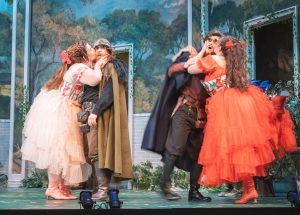
Sisters Fiordiligi (Serena Mason, far left) and Dorabella (Holly Freiberg, far right) flirt with two “strangers” (who are, in fact, each other’s fiances: Ferrando, played by Jere Burkholder, second from left, and Guglielmo, played by Felipe Araya, second from right) in Portland State University Opera’s “Così fan tutte,” by Wolfgang Amadeus Mozart, April 17 – 26, 2026, Lincoln Performance Hall, Portland. Photo: Chad Lanning.
Wildly ambitious, eccentrically creative and almost over the top, Portland State University’s Così fan tutte by W.A. Mozart and librettist Lorenzo Da Ponte proved this spring to be a refreshingly sung – if not always evenly – and imaginatively staged three-hour-long production. Two performances have come and gone (I saw opening night April 17) and two more happen this weekend: 7:30 p.m. April 25 and 3 p.m. April 26 in PSU’s 495-seat Lincoln Performance Hall that promises good acoustics.
PSU’s opera program is semi-professional – almost. The singing is not always perfect, of course: These are student productions, “grand opera on a budget,” as Artistic Director Kelley Nassief gamely wrote in a post-production email. Many projects are waiting for students’ voices to mature. Scrimping on sets and/or costumes can present problems, too.
But not this time.
Elaborate sets and costumes
The mostly mossy green set with giant handmade flowers and craftily constructed ferns of all shapes and sizes was a take on Shakespeare’s A Midsummer Night’s Dream woodland reverie. The set was repurposed from a previous PSU 2019 opera production, La Finta Giardiniera. Set designer Sumi Wu and her team crowded the stage with lush verdant exuberance. In the second act, globe-like lights resembling the moon, repurposed from PSU’s The Magic Flute, and handheld “candles” magically lit up the stage. There was even a bar, the kind where woodland half-breeds can order a drink. Layers of visuals were going on at all times. At times I wished for a bigger stage.
Filling out the stage and sets was a charming ragtag ensemble of such half-human, half-animal (and sometimes half-plant, half-human) characters as a peacock, a hedgehog, a skunk, a goat, a butterfly, a bird, a rabbit, flower fairies, a moss fairy, a tree fairy and a deer, all of which/whom had to stay in character for three hours. They made up the 12-person ensemble that spent much of the three hours onstage, even if they didn’t sing all the time. They wore groundbreakingly whimsical headwear and makeup by Diana Trapp. Costumes, which included the sisters’ oversized vividly colored floral hoop skirts, were designed by Portland’s Kelli McDonough of Inkthethink.com. When PSU’s Nassief saw one of McDonough’s fashion shows, she was smitten by the fantastical flair of the artist’s clothing and thought the designs might work for Così. In her fourth year of directing the opera program and in her seventh production, Nassief never shies away from bold efforts to reach younger audiences with classic opera. She was going for “color, modern and youthful,” she said by email.
This spring, she had a collaborator with the verve and vision to make those desires come true.
Visiting stage director Chianakas
Veteran stage director and opera singer Layna Chianakas (she has sung more than 80 Carmen performances) came to town from San Jose, Calif. via a PSU Opera program grant and thought up the opera’s overall concept to dig it out of clichés and overdone productions. Chianakas mixed A Midsummer’s Night Dream with some Japanese anime and a bit of “Dungeons & Dragons.” She updated the supratitles just enough to add humor (I saw “dude” in the titles), added quirky details, and found ways to use the ensemble cast by keeping them on stage most of the time – and in character. During her many romps around the woods, that deer stayed on its pointed high hooves.
Casting: double and triple
Undergraduates primarily made up the cast, other than the main soprano roles of sisters Dorabella and Fiordiligi. On opening night, captivating mezzo Angela Tinio, a 2024 PSU graduate, played the role of Dorabella with brio, showing off her acting, movement and singing abilities with panache while seductively manipulating her shoulderless blouse at crucial times. Graduate student McKayla Sherman, a gifted lyric soprano (though she calls herself a dramatic soprano on her Instagram) who sang the role of Dorabella’s sister Fiordiligi, delivered a first-act scintillating “Come Scoglio” aria about defiantly standing her ground as a faithful partner. Later, she pulled off a moving “per Pieta, ben mio perdona” about her inner struggle with attraction to others besides her intended. I could have listened to the sopranos all night.
With such a huge amount of Italian to sing, and a large group of opera students, Così’s main roles were double-cast. Don Alfonso (award-winning baritone Izaak Thoms) kept his role to himself. He held the piece together with his immoral compass, his hilarious rumpled long-haired professorial look and fake magician-like manner, urging along Ferrando (tenor Jere Burkholder) and the convincing Guglielmo (baritone Joey Sousa) in his ruse to prove the sisters unfaithful.
If you don’t know the plot, it’s both simple and complicated. Don Alfonso believes that he can prove women are unfaithful and fritter away love if tempted, and he convinces Ferrando and Guglielmo to test the sisters. The young men must play hidden-identity tricks on their lovers to challenge their steadfastness.
The endless and comic twists and turns of those tricks complicate the plot, but don’t expect me to recount them all. Don Alfonso does have a soft spot, or maybe he’s just faking it, which is entirely possible. When he sings the classic “Soave sia il vento” with the sisters as they wish the men goodbye, he appears sincere and caring. The song hopes for a “gentle wind” as the young men depart. Some sources argue that this trio shows Mozart at his best and most poignant, and the three singers did a good job of expressing heartfelt emotions.
Despina, the sisters’ quicksilver clever maid, was triple cast. She was reminiscent of a Playboy Bunny except she was suited out as a fox with big ears and a tail, which she swung around a lot. I saw Laurien Zahn in the role who sang “In uomini, in soldati,” lecturing the sisters (her bosses) on men’s infidelity, and trying to persuade the sisters in early feminist rhetoric that men deserve to be paid back for their behavior.
Zahn was so fun to watch. To move the plot forward and add further comedy in her half-hearted efforts to help Don Alfonso, she sings faux doctor and notary roles in opera buffa squeaky voices, playing for laughs. When she settled into the chaise lounge between shenanigans, she scratched a little den for herself to get comfortable, like any self-respecting animal. Details like these popped up all over the show, spurring audience laughter. They are a nod to the brilliance and attentiveness of guest director Chianakas, who came up with the opera’s inventive concept.
I won’t recount each crazy infidelity test in Don Alfonso’s ruse, many of which failed to prove anything, though they keep the opera moving on a comic level, if the singing and philosophical lessons go deeper than that.
“The School of Love”
Così fan tutte, roughly translated as “Women Are Like That” (meaning unfaithful and flakey when it comes to love), is sometimes called “The School of Love.” Mozart and his librettist Da Ponte had a lot to say about the unpredictability of love and courtship. The opera is the last of the trio of Mozart’s and Da Ponte’s genius late-18th-century collaborations that included Don Giovanni and The Marriage of Figaro. Così premiered in 1790 and Mozart died at 35 one year later.
Though 236 years old, Così remains one of the most staged operas, partly because it’s ideal for a large cast, it’s infinitely singable, and it delivers a ton of beautiful ensemble singing. It had several arias for each main character. In this production about 45 minutes of the original, mostly recitative, were cut. (Nothing was lost; it was already long enough).
Così’s music is a gem among melodic gems. The libretto offers an ironic and insightful take on love and fidelity with a broad-minded conclusion that leaves you wanting more and asking questions, even in these cynical times. It was not a hit in its early years; in fact it was perceived as scandalous in the prudish Victorian days, but it came to life again in the mid-20th century. Sometimes called a “symphony for six” because of the many ensembles of the principals, the opera skillfully illustrates how complicated thoughts are multi-layered, neither black nor white. Most conundrums can be perceived in multiple ways, and what better musical tool to express that than a bunch of people singing together, each expressing his or her ideas?
Not to forget conductor Ken Selden’s apt direction of the 31-piece student-musician orchestra. Three hours is a long haul for so much music, maybe even a little too long, with all due respect. Several times, the singers were out of sync with the orchestra, mostly due to the singers. Granted, it was a big sing.
In the end, the truth comes out and everyone sees the trickery involved. The sisters must decide if they’ll go back to their previous lovers, change partners, or continue to hang out as spinster sisters. In a fun twist while facing the audience, Don Alfonso holds up huge numbers for each option and asks the audience to vote by clapping for its favorite option. (The opera leaves the ending ambiguous.)
Thunderous clapping for the third option won by far on opening night. Many older people, not only students, were among those applauding for the stick-with-your-sister option. With this production, expect to be surprised.


