A cleverly calibrated marriage of live music and dance: BodyVox and WindSync’s “Drawing on the Walls”
The Portland dance company and multi-city wind quintet collaborated for a well-integrated multi-sensory spectacle presented by Chamber Music Northwest and BodyVox.
Originally Published in Oregon ArtsWatch April 2026
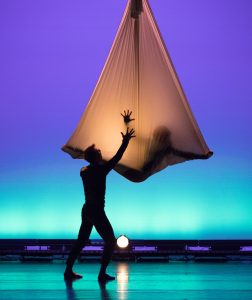
Photo by Blaine Truitt Covert.
At first glance “Drawing on the Walls,” the title of BodyVox’s springtime collaboration with wind quintet WindSync, conjured up images of kids secretly coloring their bedrooms with a rainbow of Crayolas. When the title is tagged with “humans have been telling stories since primitive people were drawing on the walls of their caves,” as it is in the program, the phrase shimmers with the power of storytelling and communicating. The sentence surfaced in the 19th century, BodyVox co-artistic director Jamey Hampton said in an April interview. Whoever said it, no one is sure.
In this context, “Drawing on the Walls” is code for telling stories, and that’s what BodyVox does so well with eight dancers moving at warp speed, creative and explosive lighting, film reels, visual surprises, humor and often edgy contemporary music. Almost 30 years old, the well-honed Portland dance company knows what to do on stage. The contemporary music, thanks mostly to WindSync’s commissions, arrangements and varied stage performance, lifted the show even further.
BodyVox has collaborated 10 times since 2011 with Portland’s Chamber Music Northwest, and this year was WindSync’s turn, courtesy CMNW. “Drawing on the Walls” proved an ideally matched performance partnership, probably its best, though I didn’t see all 10 collaborations. The dancers neither overwhelmed the musicians, nor vice versa. Each showcased the other. The innovative lighting by James Mapes and Alexander Geiszler helped spotlight the musicians even if they were hidden at times at the back of the stage — which hardly happened, and when it did the lighting compensated. The musicians moved around to different spots on the stage, sometimes with their music stands, other times without them when they played by memory. They were not the kinds of musical artists who looked at their feet during the performance.
Sharing the stage with finely tuned musicians like WindSync’s (the name is a cheeky take on ‘90s Boy Band NSYNC, bassoonist Kara LaMoure said in an April phone interview) made the stories more poignant, fresher, more alive, more spot on – and every step of the way, more cohesive, more integrated and more powerful. Performed four times April 24-26 at Portland Community College’s Sylvania campus’ 400-seat Performing Arts Center, not a single letdown marred the show. Rather, a series of engaging high points ran through the two-hour performance. It was a cleverly calibrated marriage of live music and dance.
Stories
So here’s my story of the stories: The opening piece “Drawing on the Walls” featured eight dancers and Philip Glass’s “Etude No. 17,” arranged by WindSync bassoonist LaMoure. Some fragments by Brian Eno, Fred again and Evelyn Glennie were cut in, but the music was mostly WindSync’s, each musician dressed in black, lined up artfully (not like little soldiers) in the back of the stage, setting the tone as the dancers moved in caveman- and cavewomen-ish costumes. The piece was definitely primeval and perfectly suited for the opening, though the tattered Fred Flintstone costumes lacked BodyVox’s usual metaphorical approach.
Up-and-coming composer (and one of ChatterPDX’s current composers-in-residence) Akshaya Avril Tucker’s three-part What Will You / Hold Sacred / In the Rain was performed by WindSync without dancers, as was Elliott Carter’s 1948 Woodwind Quintet, a palate cleanser in the second part of the show.
With North Indian influences, Tucker’s piece was commissioned by WindSync and composed over 2020-2026, partly during Covid. WindSync musicians originally recorded the premiere from their various homes across the country. In the final movement, “In the Rain,” Tucker writes in the program notes:
“The rain begins slowly while a mournful melody asks ‘Is it really so?’ As the rain builds, the answer arrives definitely, yes, it is; and so what will you do about it? The continued force of the rain pushes us to act via supporting one another, just as each instrument in the quintet supports and relies on each other in order to create a brilliant rainstorm of sound.”
“Impressionist” featured all eight dancers against Georges Seurat’s familiar pointillist background of “Sunday Afternoon on the Island of La Garde Jatte” and the soundscape of French composer and renowned teacher Nadia Boulanger’s Three Pieces, arranged again by WindSync’s LaMoure. Dancers and musicians wore arty 19th-century French hats for this one, and the visual artist, presumably Seurat, zoomed around on a wheeled chair as he painted. Everyone loves and knows Impressionism, so it was the most accessible piece. A Maypole-like structure that turned into a merry-go-round lifted and swirled the dancers, yet another BodyVox surprising detail.
The second half of the program was genuinely astounding, beginning with Quilt, inspired by the 1980s-era AIDS-commemoration quilt, which has 50,000 panels that stretch over 50 football fields. All eight dancers performed, wearing 1980’s-style bright psychedelic clothes, surrounding in the end the couple of Aaron Peite and Brian Nelson who created a touching and tender centerpiece love story. The accompanying music was Osvaldo Golijov’s quiet yet tough Tenebrae, an arrangement by LaMoure and world premiere for WindSync. It was originally written for soprano, clarinet and string quartet, but as LaMoure said, “the music transcended the instrumentation.” The piece has a tremor to it, with the original vocal lines inspired by Francois Couperin’s Leçons de Ténèbres. The music meshed with the dance. For some of us, tears – not of sadness – accompanied Tenebrae.
Luminance, danced by veteran one-time ballet dancer Daniel Kirk and Jillian St. Germaine, an aerial and circus artist as well as dancer, drew on aptly chosen otherworldly music by Brian Eno and Aphex Twin. St. Germaine was wrapped up in a cocoon-like cloth swaying several feet off the ground. Kirk sees her and is surprised and overwhelmed. Eventually, her hand silhouette shows through the cloth, then a leg, then her whole body, then she twists and turns and does uncanny movements inside and with the cocoon-like cloth. Kirk, curious, tiptoes around her, afraid to touch her or the cocoon at first. He eventually climbs in. The guy sitting next to me cried.
The final piece Untold featured music by Marc Mellits, a quirky (he has a piece called Parmesan Cheese) rhythm-driven composer who wrote 2019’s Apollo, commissioned by WindSync to sync with the 50th anniversary of the Apollo moon landing. With the recent Artemis mission, it was timely. Backed by pounding tracks of multi-instrumentalist jazz musician and engineer Vivek Maddala, the piece ended in a kaleidoscope of sound. All eight dancers performed. At one point, the cocoon star St. Germaine in sleek reflective moonwear wakes up in space, like a bird or a phoenix. A dreamy pas de deux with Nelson and Sammi Lopresti dressed in pristine white appeared in the movement, “Debbie Waltzing on the Moon,” which made walking on the moon passé. Waltzing is the new way to moon-walk. This piece unpacked one surprise after another.
BodyVox’s exhilarating work is “never hopeless,” Hampton said in our interview. “We don’t do ugly. If you live in sadness, nobody gets anything out of it.”
And WindSync is showing the music world how multi-channeled chamber musicians can be. They might not improvise like jazz musicians, but they can change up the pace of their music to fit the dancers and fill the stage. They can rearrange pieces and play by memory. They can perform with verve – and with the best of them.


