Classical saxophonist
Banks and eight other musicians will perform his new work "to be free," inspired by Nina Simone and the U.S. semiquincentennial, in two Chamber Music Northwest concerts July 12 and 13.
Originally Published in Oregon ArtsWatch July 2026
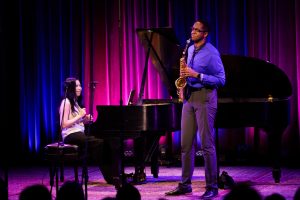
When saxophonist Steven Banks, who turned 33 on July 9, walks in the early morning and watches the darkness fade under the rising orange sun, he says he feels “complete possibility” and a touch of freedom from entanglement.
His new work, to be free – a tribute to legendary songwriter/activist/pianist Nina Simone and a salute to this year’s “America 250” theme – is a Chamber Music Northwest co-commission with the CMNW Commissioning Club. An international saxophone star, Banks will perform it with eight other musicians at 4 p.m. July 12 at the 465-seat Lincoln Performance Hall on Portland State University’s campus and again at 8 p.m. July 13 at the 699-seat Kaul Auditorium on Reed College’s campus during the second-to-last week of CMNW’s summer festival.
Aside from Banks, musicians who will play the piece include flutist Demarre McGill, violinist Claire Wells, violist Sam Rosenthal, cellist Alexander Hersh, bassist Braizahn Jones, pianist Jeewon Park, and mezzo-soprano Jennifer Johnson Cano. The mezzo has no words, though. Simone was a terrifically talented pianist, but in mid-century America, the world was not ready for a Black woman to perform symphonically. So she ended up in bars and clubs where people told her she’d make more money if she sang along with the piano. She was a reluctant singer, Banks said. So to be free has no words.
But Banks, who has earned such high recognition as the Avery Fisher Career Grant and the Young Concert Artists award – the first sax player to win both – has thought about freedom. “I wish I knew how it would feel to be truly free,” he said in my interview with him July 8 in Portland. “What would it feel like to be free of hang-ups? To live out the human desire to not be entangled?”
His piece, he says, also reflects on America at 250 years old. “How do we govern ourselves so as to be free? The founders were figuring that out as they went along, compromising as they went along.”
So there are no answers, exactly. Only music.
Following are questions and answers from the interview with the tall, thoughtful classical saxophonist who is broadening the range and depth of music for the instrument and audiences.
Oregon ArtsWatch: You took up the sax in middle school in Winston-Salem, N.C. What intrigued you?
Steven Banks: It’s shiny, a product of the industrial age, interesting to look at, not that I knew all that at the time. I started on the clarinet. The sax was a forbidden fruit thing, something I wasn’t supposed to get to play. There were already too many saxes, so I had to play the clarinet. Mom allowed me to rent a plastic sax and I learned to play it. I practiced for my band teacher, and showed him I could play it.
[Note: Banks started playing piano at 5 or 6.]
OAW: Most sax players are pop or jazz musicians. How did you pivot to classical music? Was there a telling moment?
Banks: I had a teacher in the last two years of high school – Taimur Sullivan – now a professor at Northwestern, who visited my class. I had never heard classical sax before. When I was doing band, I wasn’t that far along the jazz route. I went to School of the Arts (part of the University of North Carolina system in Winston-Salem, N.C.), the last two years in high school and started studying classical sax. It just always felt right. I was always trying to decide between classical and jazz, what to study. Going to that school changed things. I definitely didn’t think I was good enough! The students at the school cared about things so much and were always practicing. The ballet dancers were doing splits in the hall. I had the opportunity to work hard but I wasn’t overconfident!
OAW: What have been the most crucial moments/decisions in your career/life to catapult you to where you are? You’ve had a lot of roles: professor, advocate, musician, composer, performer.
Banks: The School of the Arts (above) was important. Then the Young Concert Artists auditions, which I won in 2019. Winning allowed me to have an international performance career. I was already a professor at that time, but I knew I had to be out in the world. Winning the prize allowed me to connect to the world. I was ready to do it. I was already writing and commissioning.
[Note: Banks was the first saxophonist to win the Young Concert Artists award in 2019, and in 2022, he was the first saxophonist to win the prestigious Avery Fisher Career Grant. At 24 years old Banks was teaching at Baldwin Wallace University. He has held various professorships since, most recently at Cleveland Institute of Music, the University of Hartford, Ithaca College, and in August, he will join the School of Music, part of the University of North Carolina system, his high school alma mater.]
OAW: Andre Watts, a pianist, and educator/ jazz musician David Baker of Indiana University are your most important mentors. Why?
Banks: David Baker taught jazz at Indiana University, where I went to school. I took an improv class with him. It was during one of the last years of his teaching, so it was mostly just wisdom I got from him. He said “put your own thing on the piece.” Pianist Andre Watts taught at IU, too. He was my hero, a very expressive pianist. I often heard I was too expressive emotionally. That’s why I started writing music. Watts did a 1988 performance of a Liszt piano sonata. I would watch it everyday. My mother was a big fan of his: she had a crush on him! He gave me four or five lessons, 2.5 hours each, no charge. We kept in touch.
[Note: Banks earned a Bachelor of Music degree from the Indiana University Jacobs School of Music, and a Master of Music degree from the Northwestern University Bienen School of Music.]
OAW: Who have been the most influential composers in your music? You mention Brahms. Ravel, Scriabin, who according to one source, “pioneered highly dissonant, mystical music that transcended traditional tonality. He was fascinated with synesthesia, aiming to unite all human senses through sound, color, and senses.” Are there other composers that have colored your music?
Banks: All for different reasons. Brahms, for the technique to compose music. He feels like a teacher. Then Ravel, for imagery; he makes images in music. Scriabin is multi-sensorial; with his 10th piano sonata, you almost smell it. He was a nut, but … Haydn is so visceral. If there’s joy, the music jumps off the page. He encapsulates emotions more strongly than other composers. He’s not subtle. Life is hard, he says, but there is joy to be found.
OAW: Was your mother musical? You talk about her in “Through my Mother’s Eyes,” as composing the melody she sang to you.
Banks: Yes, she (Shelley Noisette) was an elementary school music teacher. She loved music. She was very creative, always making her own stuff. She wrote a children’s book series for us as kids called Star Bunnies.
[Note: Banks has three older sisters. “Through My Mother’s Eyes” was performed on the violin at the July 8 CMNW New at Night concert at Alberta RoseTheatre.]
OAW: You talk about your “double consciousness” (coined by W.E.B. DuBois) expressed in the notes accompanying “Come As You Are.” How do you work that idea out as a composer? Or as a person? DuBois explained double consciousness as Black people seeing themselves through the lens of racially prejudiced white people, which caused a “split” consciousness.
Banks: Everyone hears something different when they hear that piece. I heard some Rachmaninoff or Schumann, people have said when I play it on the East Coast. When I play it in the South, the audience knows the hymns; they are actually part of the culture. It creates a different experience every time I play it or others hear it. When I started writing it, it was too much of a Euro-classical piece. It didn’t feel like fullness for me. I started over. When I grew up, classical music was considered “white people’s music.” This piece has a wide range of cultural influences, gospel-like feelings. You have to zoom out.
OAW: Critics say you are destined to become one of the most transformational musicians of our time. How do you interpret that?
Banks: As a classical saxophonist, everything you do is not a normal thing. For me, to have a career, I have to figure out what that means, being a classical saxophonist. It’s very involved in the “double consciousness” thing. I think more about diversity in deeper ways than programming and inclusion. How is this music actually ours? It is about cultural inclusion beyond programming. When I’m playing concerts, I’ll go anywhere in the Black community and play and talk about music and give them tickets to the concert. It’s not a youth initiative. I want the aunties, the barbershop people to come to this thing. It feels basic; I’m not doing that much. It’s the small things that change the audience. I focus on music as storytelling. Everyone there gets tickets and I’m bringing people to the concert. It’s not just outreach.
OAW: “The saxophone cries, sighs and dreams. It possesses a crescendo and can gradually diminish until it is an echo of an echo, I know of no other instrument that possesses this particular capacity to reach the outer limits of audible sound.” You use this quotation by Romantic composer Hector Berlioz on your website, and have an album called Cries, Sighs and Dreams. How does it speak to loneliness and isolation? This seems to be something you and all of us wrestle with.
Banks: The quote and LP and piece on the LP titled Cries, Sighs and Dreams reflect the fundamental yearnings of being human. Many people at that time (early to mid-19th century when Berlioz wrote about the saxophone) were not saying nice things about the saxophone, The quote says the instrument goes even a layer deeper than “singing,” which everyone thinks about their instrument. The piece, “Cries, Sighs and Dreams,” is a COVID piece. I was living in Ithaca, N.Y. and isolated. The piece uses the quote from Berlioz and has sounds of crying. It was a terrible time. Having a COVID piece is almost a trope now. Everyone seems to have one. There is acceptance in the end of the piece with a beautiful aria that has a lingering sound of dissonance. It is about finding beauty in spite of dissonance.
OAW: Who are your favorite saxophonists?
Banks: You won’t know them, but Daniel Gauthier, who’s German; Arno Bornkamp, who is Dutch; and Taimur Sullivan, a professor at Northwestern University. John Coltrane? As an artist, yes. He could have worked on his altissimo!
[Note: The altissimo register on an alto saxophone refers to the notes that lie above the instrument’s standard keyed range—typically anything higher than high F or F#. Playing in this range requires advanced voicing techniques, a controlled embouchure, and specialized “false fingerings.”]


