Emerging dancers
push/FOLD's sixth annual festival of contemporary movement includes companies from Oregon and beyond, and features both Portland and world premieres.
Originally Published in Oregon ArtsWatch May 2026
Several all-over-the-map UnionPDX Festival 26 performances unfolded from May 27 through the 31st at southeast Portland’s newly renovated, sleek black-box-style 150-seat Foster Theater.
The festival, an outgrowth of the eight-year-old Portland push/FOLD dance company, celebrates emerging and lesser-known contemporary dance artists, with the intention of adding education, grant-writing skills, community, and performance as dancers grow into professional roles.
The festival is the brainchild of push/FOLD directors Samuel Hobbs and Holly Shaw, and has been happening since 2019 with a couple of live-performance breaks, though livestreaming has helped to keep the festival going. This year, tickets run from $5 to $65. There’s a bar on the Foster Theater’s second floor, and all-gender bathrooms give the venue a neighborhood come-one-come-all vibe, having been bought and renovated by classical ballet director Sarah Rigles. It officially opened in the fall of 2025.
Three of this season’s pieces were Portland premieres, and two were world premieres. UnionPDX curates from all over the world, and a panel chooses the participants. Each dance lasted 10 to 20 minutes, not a moment too short and sometimes too long. There was no live music, other than drumming, but there was plenty of electronic music.
One piece, Alice in the Nite Hawk, was a film, choreographed by prolific dance-maker Heidi Duckler. She won a 2021 Oregon Arts Commission Fellowship, and in 2024 she made a film called Mother/Other that won the best Experimental Film at the Cannes Arts Festival. So the festival was not without a few recognizable names.
But despite the lack of live music other than drums, and celebrated names in the dance field, the two hours (plus a post-performance back-and-forth conversation between the audience and artists) were engaging and encouraging: The festival is proof that plenty of contemporary-dance talent exists, even if names don’t ring an immediate bell,
Let me start with my favorite of 2026’s festival offerings: Rosanna Tavarez’s Hybrids of Plants and Ghosts was inspired by a poetry book by Jorie Graham. The piece was danced to an audio of spoken interviews about Tavarez’s beloved yet complicated grandmother, who reared seven children.
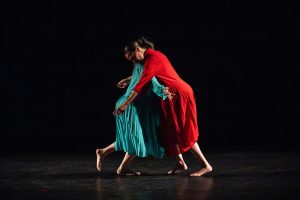
She was strong, diffident, hard-working and overworked, and often mean or angry. But Rosanna loved her, and she loved Rosanna back, and the piece captures that in a subtle way. Tavarez dances the part of the grandmother, wearing red, and Jen Hong, in green, performs the shadowy roles of sisters, aunts, daughters, granddaughters and other women who have shaped and experienced the grandmother’s life.
The two women dance together but not necessarily as a unit. They are not carbon copies of one another. Tavarez and Hong have been working on the piece for nine years. Both are nearing 50 years old, though you’d never know it by their lithe moves that often engaged the stage floor – and for which they wore knee protectors.
The grandmother eventually falls into Alzheimer’s, and the women dance that part, too. Tavarez is an accomplished Countertechnique teacher and the BFA Program Director at California Institute of the Arts. Her movement is strong, precise and complicated, revealing a complex woman with just enough drama to keep you caring about the character. Little by little, she loses focus and walks off the stage. An elegant dancer and speaker, Tavarez said after the show that people are complicated; they are many-faceted. There are so many ways to view them, and so many ways in which they view themselves, even a beloved grandmother.


