“Hold Fast”: A poetry and music collaboration
The orator and composer reunite to present their "Hold Fast to Dreams: The Poetry of Langston Hughes" in late May as a springtime prelude to the August festival.
Originally Published in Oregon ArtsWatch May 2026
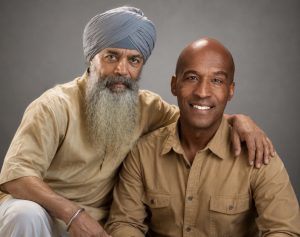
The last time Darius (DUH-ree-us) Wallace and Jasnam (like VietNAM with accent on the second syllable) Daya Singh performed a Langston Hughes poem was in a 2022 Portland Chamber Orchestra show. My Words Are My Sword was a rousing program of spoken-word artist Wallace passionately reciting poems and prose of Black thinkers and artists as he strode up and down the aisles of North Portland’s St. Andrew’s Catholic Church. The words were complemented by Daya Singh’s multi-cultural music. In 2009 Daya Singh won a Grammy nomination in Latin Jazz for Live at Caramoor, a recording with Brazilian pianist Jovino Santos Neto at the jazz festival in upstate New York.
At the time of My Words Are My Sword, Daya Singh was the composer-in-residence for the recently defunct PCO led by the beloved Yaacov “Yaki” Bergman, who died in 2023. Bergman also headed up the summertime Siletz Bay Music Festival on the Central Oregon Coast, which will host Wallace’s and Daya Singh’s newest collaboration, Hold Fast to Dreams: The Poetry of Langston Hughes. The festival recently hired a new executive director, Daniel Pack, a cellist and former arts administrator.
Over the last four years, the two artists have stayed friends and creative collaborators, though Wallace lives in Conyers, Ga. outside of Atlanta, and Singh in Vancouver, Wash. An in-demand spoken-word artist and actor who often performs historically researched pieces for schools and other organizations, Wallace has persisted in his love of Hughes’ powerful plain-spoken poetry and its easy adaptation to performance and music. “Hughes’ poetry is populated with people, so there are characters. They’re curious, tragic, wise. His poems are a biography of people and you may see your own biography,” Wallace said in a Zoom call in April. However, the show is not a biography of Hughes though you will surely piece together the poet and playwright’s life as the poems unravel.
Presented by the Siletz Bay Music Festival at the Lincoln City Cultural Center on the Oregon coast, the show will add a free performance at Lincoln City’s Taft High School, open to all students. Two ticketed shows are 7:30 pm Friday, May 29, and 2 pm Saturday, May 30. Tickets are $30, and $10 for students with ID at SiletzBayMusic.org. The rest of the 15-year Siletz Bay Music Festival, which promises a number of eclectic concerts from classical to jazz to hip hop to folk, will take place from Aug. 13-23 in various Oregon coast locations. Hold Fast, though not part of the summer program, providesa robust springtime appetizer.
Starting with 40 musical poems of towering Black wordsmith Hughes, who lived from 1901–1967 and spearheaded the Harlem Renaissance in mid-century America, Wallace figured Daya Singh could compose fitting music for each poem. Singh decided a hand-picked quintet would play his music, and added musicians with whom he frequently works, including bassist Bill Athens (3 Leg Torso, Trio Subtonic), drummer Ken Ollis (Portland Jazz Composers Ensemble), flutist and alto saxophonist John Savage (Kennebec) and cellist Collin Oldham (Elysium Quartet, Portland Cello Project). Daya Singh composes on the piano and will play the keys during the performance.
Matching the emotion of the poems
Well Son, I’ll tell you:
Life for me ain’t been no crystal stair.
It’s had tacks in it,
And splinters,
And boards torn up,
And places with no carpet on the floor–
Bare;
But all the time
I’se been climbin’ on.“Mother to Son”
As Wallace performs such pieces as “Mother to Son,” “Harlem,” “Let America be America Again,” and the early 1920s “The Negro Speaks of Rivers,” the quintet will accompany with Daya Singh’s original music. Don’t expect the musicians to drown out or upstage the poet’s words. “Soft is our home. From there we go anywhere,” Daya Singh tells his band members.
Daya Singh said his mission was “to come up with music that matched the emotion of the poem.” His process was to set his thoughts on the piano with computer software and then send the music to Wallace, who mostly heartily approved the matches. One piece, “Black Clown,” “didn’t match the dissonance of the poetry,” Daya Singh explained on a Zoom call in April. So he went back to the piano and used the music as an interlude. “The music didn’t go to waste,” said the Brazilian-born composer, who calls his music “a melting pot of cultures.”
What happens to a dream deferred?
Does it dry up like a raisin in the sun?
or fester like a sore –?
And then run?“Harlem”
Many of Langston’s verses have dream imagery, said Wallace. “Dreams come up a lot in the poetry. Pursuing, deferring, struggling. The poems show touches of all of those elements through humor, tough experiences, struggle.”
Shake your brown feet, honey,
Shake your brown feet, chile,
Shake your brown feet, honey,
Shake ’em swift and wil’–
Get way back, honey,
Do that low-down step.“Song for a Banjo Dance”
And though Hughes wasn’t a musician, he was inspired by music and saw it as integral to the Black experience. Much of the rhythm of his poems is based on blues, jazz, and presciently, hip hop and rap. In the 90-minute show, Wallace will sing several of the poems in his baritone-bass.
Let America be America again.
Let it be the dream it used to be.
Let it be the pioneer on the plain
Seeking a home where he himself is free.
(America never was America to me.)“Let America Be America Again”
Wallace argues that, in these current racially charged times, “Hughes’ poetry is more relevant now than even a few years ago, when Black Lives Matter surfaced. It touches on the nerve of humanity. There are external forces that we can’t control but we’re still affected. Hughes continues to dream and address his thoughts through humor and tragedy … his people are finding a way to deal with the cards that they are dealt.”
I am the fool of the whole world.
Laugh and push me down.
Only in song and laughter
I rise again—a black clown.
Strike up the music.
Let it be gay.
Only in joy
Can a clown have his day.“Black Clown”


