Montréal’s jazz fest
Featuring Joshua Redman, Hiromi, Stacey Kent, and Béla Fleck's new BEATrio.
Originally Published in Oregon ArtsWatch July 2026
MONTRÉAL – This summer, from June 25 through July 4, the Festival International de Jazz de Montréal in Canada, the world’s biggest jazz festival, was drawing as many as 2 million visitors to Montréal’s downtown. It featured about 3,000 artists from more than 30 countries. Playing in the downtown core and arts district closed off to cars, the event drew emerging artists, old favorites like Taj Mahal, and such top-drawer big names as Joshua Redman, Hiromi and Béla Fleck, who were in the mix this year, the festival’s 46th anniversary. Though jazz and its many iterations remained the festival’s heart, plenty of soul, hip-hop, bluegrass, and world music fluttered and beat around the edges of the festival.
Most concerts were free, except the biggies that featured headliners. I was one of the lucky projected 2 million visitors who heard those big names. Let me send you a few postcards of their performances.
Joshua Redman: Jazz statesman
Joshua Redman, now a bit of a jazz statesman in a chic European-styled jacket and tie, shirt cuffs showing, said he remembered when he came to the festival right out of college (he didn’t mention that it was Harvard) in the early ‘90s with his dad, saxophonist Dewey Redman, who played with Ornette Coleman and Keith Jarrett, among others. That was 35 or so years ago.
The younger Redman now has a new band he shaped sometime around COVID with pianist Paul Cornish, bassist Philip Norris and drummer Nazir Ebo. They all put a fresh twist on the newest Redman album, Words Fall Short, with such pieces as “She Knows,” “So It Goes,” “I Want to Dance All Night with You” and “Borrowed Eyes.” Redman seemed to be at the top of his pretty much impeccable straight-ahead jazz game with these guys, and he gave each plenty of space to perform. They’re all good, but Norris shone brightly as a skillful bassist. They played June 29 at the 1,453-seat Théâtre Maisonneuve in downtown Montréal. Redman played two encore pieces, and his composing, improvising and creation of clever bittersweet song titles remind us of what a jazz presence he has been over several decades.
Hiromi: Impossible to put in a box
Hiromi, the tiny Japanese-born 47-year-old keyboardist who picked up jazz as a kid while she was learning classical piano, is impossible to put into a box, nor can you wedge her music into a genre. Though she started out playing classical music, she pivoted to improvisation, moved to the United States in 1999, and attended Berklee College of Music in Boston where, within a few years, her career took off.
A sprightly bandleader, she has a pile of hair on her head that threatens to spill onto her two-keyboard piano (one is on top of the piano) or onto the nearby electric piano, which she jumped to, and where she added another set of notes to her relentless improvisation. She is a kinetic star who never stops moving. She played with trumpeter Adam O’Farrill, drummer Gene Coye, and Hadrien Feraud on the electric bass. Hiromi and her Sonicwonder band raced through her albums that fuse jazz, acoustic, classical, funk, high-energy and nonstop improvisation. Don’t ask me exactly what they performed, but the tempo was mostly frenetic.
Her work is electric, eclectic, eccentric, energetic and hard to pin down. Her first album Another Mind went gold in Japan and was named the Best Foreign Jazz Album of the year in 2004. Produced by late, great pianist Ahmad Jamal and Richard Evans, it kicked off her worldwide career, which has rarely slowed down on stage or off. Her most recent LP, Out There, most certainly was out there.. She and Sonicwonder drew from that album and others in her breathless 90-minute show June 28 at theThéâtre Maisonneuve at Montréal’s Place des Arts. No encores here — more than likely, the band was burned out after such a performance.
Stacey Kent: Smooth as silk
Anyone who can sing Antonio Carlos Jobim’s “Waters of March” makes my A-list. Jobim wrote the lyrics in Portuguese and English of the wordy, image-filled song that mimics falling rain. Crooner Stacey Kent, who is American and fluent in French – and wanted the June 30 Théâtre Maisonneuve audience to know it (after all, we were in Quebec) – sang the song in French, and you know, that 1970s-era semi-ballad that so few singers approach due to its tongue-twisting lyrics, was rendered more beautiful than I’ve heard before.
Kent has a smooth-as-silk, perfect-pitched alto and a terrific sideman in her husband Jim Tomlinson, who plays sax, flute and occasionally harmonizes along with her in his gentle tenor. He is her primary arranger and without him – well – he helps to make her a very good singer and musical interpreter. Pianist and composer Art Hirahara rounded out the trio; it would have been even more of a hit in a smaller, more intimate venue.
Her show started slowly with a few too many stories told in French, but once she leaned into the late Brian Wilson’s heartbreakingly tender “God Only Knows,” followed by Stevie Wonder’s “I’ll be Lovin’ You Always” after coasting through Burt Bacharach’s and Hal David’s mid-century “Trains and Boats and Planes,” I knew I’d come to the concert that nostalgic Baby Boomers were hoping for. Earlier she sang a Leonard Bernstein favorite, “Lucky to be Me,” as well as “Shadow of Your Smile,” some cuts from her recent A Time for Love album and earlier Breakfast on the Morning Tram, but all of them paled next to her “Waters of March.”
Béla Fleck: New musical universes
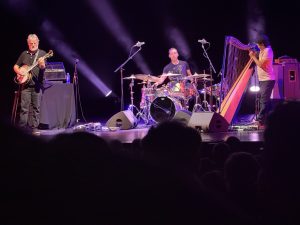
Béla Fleck never stops surprising, evolving, changing, pushing himself into new musical universes despite the many Grammy awards that have already secured his reputation as one of the best instrumentalists on the planet. This time on July 1 at the Théâtre Maisonneuve, he showed up with his new band BEATrio (“B-E-A Trio,” named for the three musicians’ first initials), including irrepressible banjo wizard Fleck, masterful Colombian harpist Edmar Castañeda and dynamic Mexican drummer Antonio Sánchez. Yes, they all deserve those adjectives.
Believe me, you’ve never heard anything like these guys. Sánchez called them the “weirdest band in the world” when he took the mic to introduce the trio. Fleck, who didn’t open his mouth until the end of show, letting his bandmates take the lead, is astonishing enough with the tunes he picks and plays on his banjo — strung for bluegrass, classical, chamber, jazz et al — but add Castañeda’s harp to that, and the surefooted drumming of Sánchez, and the sound emerges otherworldly. And not in any woo-woo way, rather intense, powerful and oddly harmonious. You want more and more of it and worry that the musicians will wear themselves out at the same time keeping up with their own music. After all, the harp was bigger than Castañeda, yet he managed to pluck the most – and more – from it.
They played from their new album, BEATrio, out this spring. Each of the musicians composes, and though Fleck’s name is the most recognizable and Grammy-fueled, their music shows off each artist’s brilliance. If you think a Latin edge dominates, it doesn’t. The explosive sound is totally original. The trio whipped off most of their new album with “Archipelago,” “Kaleidescopes,” “Whispers of Resilience,” “Cloak and Dagger” and “Pellucidar,” along with a couple of encore pieces in a generous hour and 45 minutes.


