All greatness is improbable: Madeleine Peyroux, Shelly Rudolph and Brandon Woody’s Upendo at PDX Jazz Fest
Three concerts from the recent Biamp PDX Jazz Festival featured dazzling singers and a quartet that was perhaps too loud for the venue.
Originally Published in Oregon ArtsWatch March 2026
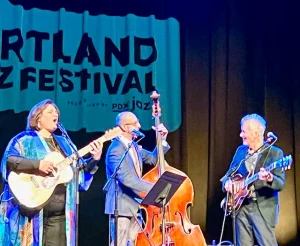
Madeleine Peyroux Trio (L to R: Peyroux, Barak Moin, John Herington) at Revolution Hall for Biamp PDX Jazz Festival. Photo by Angela Allen.
This year the 10-day Biamp PDX Jazz Festival was pushed into March to avoid anticipated bad February weather. From March 5–14, the festival put on more than 50 citywide concerts, many free and featuring local artists, and 10 nights with internationally celebrated artists, several of them double-billed. There were 11 sellouts of 19 ticketed concerts by the end of the festival.
I heard two headliner concerts – three concerts, when you count the well-received performance of Portland vocalist Shelly Rudolph and guitarist Dan Gildea who played before Madeleine Peyroux took the stage March 6. Upendo, a jazz quartet starring trumpeter Brandon Woody, was an ear-buster, resulting in the disappointing performance of a touted Blue Note musician. My reviews are below.
Peyroux preeminence
When Madeleine Peyroux was busking in Paris as a teenager, she was “discovered,” suddenly became famous, and word spread that she sounded like Billie Holiday.
That was some 35 years ago, and the musician we heard March 6 at Revolution Hall during the second night of the festival was a far different artist from that American-born teen phenom.
In middle age, she is more Nina Simone than Billie Holiday. Though I’ve heard Peyroux several times and don’t know her personally, I‘m betting she’s more sure of herself than ever. At 51, she dominated the stage in a colorful filmy flowing robe, playing acoustic guitar, joking with her trio and the audience. The chanteuse quality of her singing was only part of her repertoire.“Catch a Falling Star,” made famous by Perry Como in the late ‘50s, and Judy Collins’s “Sweet Dreamers” were among the ballads she sang, but her fierce protest songs and story-telling tunes from Randy Newman and Paul Simon were bigger parts of the show. As were some hilarious and nonsensical I Ching quotes that Peyroux read, tongue-in-cheek, to give her artistry a rest, such as “All greatness is improbable. What is probable is tedious and petty.”
She rolled her eyes with the rest of us. She has a sense of the absurd and kept most of us, including her fellow musicians chortling along with her.
Among the two dozen songs she performed with longtime bass player Barak Moin (“he still looks the same,” she joked, after 20 years) and guitarist/collaborator/arranger John Herington, was “Let’s Walk,” which she sang toward the end of the show. It came straight from the depths of her social justice-seeking heart, unleashing her tenor range, and encouraging us to do something about the dismal state of our country. Here goes:
Let’s walk, let’s roll
you are the people of my heart and soul
I want the world to know
Let’s Walk, released in 2024, is her ninth and most recent album (her 2004 Careless Love went gold), and perhaps the most political and heartfelt. She and Herington, a onetime Steely Dan arranger, wrote all the songs.
Peyroux is so versatile, so smart and so engaging that she was able to take us on a 90-minute tour of dozens of immigrant composers from Italy, Hungary, Ireland, Eastern Europe, and many parts of the African diaspora. They make up some of the high points of America’s soundscape of memorable music. She performed songs from Perry Como, Louis Prima, Wizard of Oz composer Harold Arlen, Randy Newman, Paul Simon, Judy Collins, Hank Williams, Allen Toussaint, Billie Holiday – “all who made momentous changes to our music and bridges to the entire world,” she said.
A seasoned performer who wrapped us up in her take of Americana, jazz and blues, Peyroux has an unpretentious yet unsentimental gift of making everyone feel welcome.
Rudolph and Gildea
Peyroux didn’t come on stage till about 9 p.m. after an hourlong performance by Portland jazz vocalist Shelly Rudolph, who sings in French as well as she does in English.
She and ultra-talented understated guitarist Dan Gildea performed about a dozen songs. They’ve been playing together off and on for decades (he studied in New York with bassist Ron Carter for a while) and their cohesion and rapport were unmistakable, their harmonies easy to listen to, and their rhythm spot-on as if they had practiced with a metronome for centuries. The guy sitting next to me loved Rudolph’s skintight black and red sheath and long wavy hair, and she was a fluid mover, which made her voice all the more attractive (ha!). As respectable a jazz crooner as she is with the 2020 LP, The Way We Love, she can entertain solo, but she is better with Gildea, who brought the best out in her with his sizzling yet sensitive accompaniment. By the way, she is married to guitarist Chance Hayden, so she gets plenty of practice with guitarists.
Rudolph is part mermaid, part chanteuse, part R&B and jazz singer. Though she sang a bunch of standards in her breathy mostly alto voice, her best arrangement was John Lennon’s “Imagine,” her show’s last tune. The audience eventually sang along, knowing that it got a helluva show several grades above and hotter than most warm-up performances.
Upendo: great name, too loud
Upendo opened the Biamp PDX Jazz Festival March 5 at The Old Church with Baltimore trumpeter Brandon Woody leading the quartet.
Even though Upendo played at Lincoln Center, gleaned praise for its juggernaut-like vibe, produced a Blue Note 2025 LP, For the Love of It All, the group didn’t get the sound right at TOC, which any jazz musician will tell you is a tricky space to play.
The performance with bassist, drummer and pianist, aside from Woody, was unlistenably loud. A number of people in the audience, including me, left at intermission because our ears couldn’t take the headbanging sound. The guy sitting two seats to the left of me – and we were in the back of the church – kept his ears covered and his head down the entire first part of the performance. This was supposed to be jazz, not hardcore 70s rock.
In the first hour of the concert, the tunes were long – about 8 minutes each – and sounded similar. I did enjoy the first part of the opening song when the piano and trumpet played, quietly and clearly, and the sonic competition was at a minimum. Such a promising start.
Here’s what Portland jazz drummer and bandleader Christopher Brown had to say about the performance. He heard the entire show. We spoke at intermission and caught up later by email.
Sound should come first
“The unforgiving nature of TOC demands a high degree of attention to detail in sound management from musicians and sound engineers. When bands are too loud, it’s often due to the volume of the bass. And when other musicians can’t hear themselves as clearly as they’d like, their natural tendency is to play louder, which in turn makes the bass turn up, perpetuating this cycle. The bass was turned up too loud, which forced everyone to play louder, promoting a lack of clear harmony and rhythm.
“The drums weren’t muffled enough for the space. In general, the busier a drummer is, the more he has to minimize the resonance of his drums if he wants his ideas to come across with clarity, not to mention the ideas of others. Unfortunately for this performance, the tuning of the drums wasn’t optimized for TOC. It wasn’t just the drums, the pianist overused the sustain pedal, clouding the rhythmic and harmonic clarity of his ideas as well. So when you couple all of that with fast trumpet playing in a space like TOC, all you get is an unclear wall of sound.
“While each musician was clearly skilled on his instrument, they didn’t gel as a unit. If anything, this performance should underscore the idea that while technical fluidity can get your attention, it’s not enough to hold it in the end.
“The biggest inhibitor to a great performance (especially jazz) is when artists have to work to hear each other. So while spreading out a band on stage may look aesthetically pleasing, it’s much better for musicians to set up as close to each other as possible. That promotes softer playing, which in turn promotes more subtle nuances and a greater dynamic range as a consequence of not needing to play as hard. This strategy would have solved so many problems for both the musicians and the audience.”
Like a good dinner party
“Whether we musicians accept it or not, we’re in the service industry. And like any business, our biggest challenge lies in keeping our customers delighted while staying true to the values that earned us recognition in the first place.
“Like a good dinner party, a performance should be an energetic arc that’s pre-planned. And in the case of a show (especially a jazz show), the design of a setlist is to keep people leaning in as opposed to leaning back. Unfortunately, too many of the songs had a similar rhythmic, melodic, and harmonic sound. And when that persists for too long, an audience’s ear and attention will begin to fatigue. Also, there didn’t seem to be enough clear harmonic demarcations for when one person would end a solo and the next one would begin. They just seemed to end rather abruptly, almost as if those shifts were catching them off guard.”
Maybe if Upendo returns to Portland they’ll have a better idea of how to control their sound to make the most of their talent.


