Young muscians star in Portland
YAI, a part of CMNW's summer festival for the last five seasons, gathered 16 string players from all over the world for a series of concerts, masterclasses, and collaborations with local young composers.
Originally Published in Oregon ArtsWatch July 2026
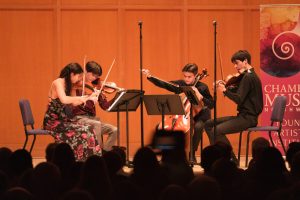
There was a moment when 18-year-old violist Eishin Richard Hiraishi broke into laughter as he took the microphone before Lococo Quartet’s performance. It was the final night, July 4 at Kaul Auditorium, for the 16 string musicians of the Young Artist Institute to show their stuff. While introducing Maurice Ravel’s String Quartet in F Major, the tall violist from Muncie, Ind. watched his laughter spread contagiously. His quartet colleagues (violinists Leila Warren, 17, and Leo Trajano, 18, along with cellist Samuel Dangerfield, 16), poised to perform, failed to suppress their smiles and giggles. But the show went on, and the four settled into Ravel’s quartet that they’d practiced together for three weeks.
There was another moment when Mason Lee, an 18-year-old violist, was shooting photos of his fellow YAI students June 19 at The Old Church during the first solo showcase, and several YAI girls, though watching their fellow musicians perform, crowded together and mugged, perhaps hoping to show up on Lee’s Instagram.
Yep, these 16 ultra-talented string players in Chamber Music Northwest’s five-year-old, rigorous, one-of-a-kind youth program that CMNW Artistic Co-Directors Gloria Chien and Soovin Kim pledged to make world-class are still teenagers. They are training to be the next generation of classical musicians. They perform with tablets rather than sheet music, and are learning how to collaborate and support one another as they play together.
From all over the world, including Singapore, China and Mumbai, these young musicians aged 15 to 18 play well above their pay grade. Their concentration and drive are immense. When violinist Jing Metz, 17, from Alfred Station, N.Y. played Ravel’s “Tzigane” during her solo showcase June 19 at The Old Church, a garbage truck backed up outside the church, its relentless warning beeps determined to throw her off. She didn’t miss a note. She was utterly steely-nerved, not unusual for this group of young musicians.
In Portland for three weeks since early June – and performing 25 times this summer at preludes before CMNW mainstage concerts, for pop-ups, community concerts, master classes and on radio shows – they were each on full fellowship, which included room and board at University of Portland, airfare, classes, concerts and such diversions as bowling, berry-picking and visiting Multnomah Falls. Most have resumes a mile long – they started playing music at very young ages – and some have appeared with major symphonies, while others have performed at Carnegie Hall. All have won numerous accolades for their work. Judging by their playing – solo or in quartet – and by their choices of repertoire, such as Brahms’ Cello Sonata No. 2 in F Major, Op. 99, which 16-year-old Timothy Chua of Singapore played, or 17-year-old Euisun Hong’s performance of Erich Wolfgang Korngold’s Violin Concerto in D Major, Op. 35, they could pass for pros. Which they are learning to be.
Student selection
All students are invited back every year, so they can attend for two years unless they have graduated from high school. This year, Christie Cheung, 16, a violinist from Toronto, Ontario in Canada; Griffin Frost of New York, N.Y.; and Isabel Jing Metz of Alfred Station, N.Y. returned for a second year.
Students are chosen in a variety of ways, said CMNW co-artistic director Soovin Kim and YAI program head, and there is no formal application process. There are no open auditions. “We’re always trying to include Portland-area students and students from the Pacific Northwest (there were several this year). It is not a cut-and-dried application process. We try to do our best to get the best chemistry with a variety of ages, gender, locale.”
Many recommendations come from teachers, students, parents and chamber music musicians and insiders. “We want to know about anyone interested in coming,” said Kim, who is a world-class violinist and heads up the program. He does his best to reach kids who are not from metropolitan areas or who have less celebrated profiles than those from better known places – those who are not the “most obvious candidates. That was me. I grew up in upstate New York. It would have been the perfect program for me.”
Teachers are key in helping to choose the participants. “Teachers from around the country are a huge network. They’re in touch with one another about a variety of things. We’re really embedded in the teachers’ world. Teachers recommend their gems, but they don’t always have someone ready for the program, but might let us know that they have a 12-year-old for future years.’”
The ability to collaborate with fellow students is important, as important as raw skill. Most students who are considered for the program are highly skilled. “We get a lot of students who are incredibly able but inexperienced in collaborating,” Kim said. “That doesn’t mean we’ll exclude them, but we’d much rather have team players than prima donnas.”
The students, teachers and YAI staff meet on Zoom before the institute starts. The YAI teachers have a chance to think about how the students will fit together in a quartet and how to best incorporate their special skills.
“They have to be able to put their egos aside,” said Peter Bilotta, Chamber Music Northwest’s executive director. This season, he added, the young artists have been more exuberant than in other years. “They had a passion to play — every year gets better.”
“There was especially great chemistry this year,” Kim said. “It’s a once-in-a-lifetime opportunity for teachers and these mega-talents. This kind of thing doesn’t happen in life very much. There isn’t time and space.”
Collaborative pianists, unsung heroes
Aside from working daily with top-notch professional musicians — including violinists Soovin Kim (also CMNW co-artistic director) and Jessica Lee; violists Dimitri Murrath and Nicholas Cords; and cellist Peter Stumpf — the students practice and rehearse closely with collaborative pianists Jiarong Li and Pualina Lim.
These two musicians are highly trained professional pianists. Li studied at New England Conservatory and Manhattan School of Music, has a Master of Music in Piano Performance, and finished her collaborative piano fellowship at the Yale School of Music. Lim studied solo piano in Singapore, and has a Master of Music in Collaborative Piano from New England Conservatory, and later completed graduate diploma and certificate programs.
The string players worked with Li and Lim every day, perfecting and better understanding their performance pieces. The unsung heroines of the program, the pianists dress often in black and blend seamlessly with the grand piano. They encourage the string musicians to find the nuances in Schubert’s sonatas and Saint-Saëns’ rondos. They do far more than simply accompany on the piano. They give support, insight and courage to the young artists. Any recital? Pop-up? Prelude? They’re playing the piano while the string players stand front and center. With the 25 events and concerts that the YAI students played during the program’s three weeks, these pianists had to learn an immense amount of repertoire in a short amount of time, even if they were familiar with much of it.
Even if worked to the bone, they bonded with the kids.
“I am like an approachable older sister,” said Lim, who worked with the four cellists, all boys this year. “I strive to provide a nurturing and safe place for the students to try different ideas. And as someone older with more experience, I try my best to give suggestions and to guide them. Onstage, I strive to be their supportive and reliable collaborator as we create beautiful music together.”
Li, who worked with the eight violinists and violists this summer and likes to play Bach to warm up in the morning, said she was impressed by the “fresh perspectives” of the talented young musicians. She has a lot to teach them throughout the process: “Learning to communicate spontaneously, respond to harmony, and actively listen to one another in the moment are important parts of the collaborative process.”
If a student falters in performance, she said, “we stay calm and keep going. Live performances are unpredictable and part of our job is to support our partner and stay cool.”
In one showcase, a cellist’s instrument slipped, and the piece went on with little pause, thanks to Lim, who loves to play Schubert if pressed to choose her favorite among numerous composers. “We are their stable and dependable rock, and are ready to jump in and catch them whenever and wherever! It feels as if my antennas are extended and hyperaware when a slip happens.”
Working with young composers
These young musicians play much of the classical canon throughout their early years of training and during the YAI workshop. Most of the composers whose music they perform and practice are dead. At the institute, they have the chance to play pieces by young composers their own age. The collaboration is one of the most exciting aspects of the program.
On the final showcase night, this year on July 4, the four YAI quartets – each with two violinists, one violist and one cellist – played one piece by composers Schumann, Mendelssohn, Ravel or Dvořák. Their second piece was composed by one of four students in the 29-year-old Young Composers Project, an educational arm of Portland’s Fear No Music.
The composing students are in 6th through 12th grades, and some stick with the program for several years. As director Jeff Payne said, the training “helps students realize their musical ideas” and deals with such things as “fixing notational problems, learning about the ranges and performance problems of the instruments, developing the form of a piece, trying different instrumental combinations, or experimenting with instrumental colors and special effects. As far as we know, the workshop format that we use is the only one of its kind in the country,“ and has produced a lengthy list of state, regional and national composition winners. As well, numerous students have gone on to pursue successful careers as composers in various fields, Payne added.
This past year, 36 kids were in the program. Among them was Skye Neal, who plays piano and violin, sings, and rows with Rose City Rowing Club. She composed Bloom about the coming of spring for the Young Artist Institute. Amelie Wright, 17, who is headed to Princeton in the fall and plays violin, sings and performs in theater and musical theater, drew inspiration from traditional Japanese music and contemporary string techniques and composed o, awake! about a spirit waking up.
Elishiya Crain-Keddie, a third composer, plays cello, piano, viola and bass and just finished her freshman year at University of Southern California, where she’s majoring in composition. She wrote Oregonian Suite about various places in Oregon, which included some jazzy riffs reflecting parts of north Portland. Maxwell Evans-McGlothin, a pianist, soccer player and student council member who just graduated from Cleveland High School, composed Quantitative-Qualitative, which spoke to the degradation of this country’s democracy.
Each piece is brand new, commissioned by Chamber Music Northwest. The composers “are given free rein to write what they’d like and the top-notch capabilities of the YAI performers mean that they don’t have to worry about writing music that’s too difficult for young performers,” Payne said. “The pieces were beautifully crafted and showed a deep understanding of how to write for the instruments in a string quartet, a skill that is not easily mastered.”
The YAI students began rehearsing the compositions when they arrived at the institute in June. The composers met with the students the day before the final performance for an hour of rehearsing, coaching and answering questions. “I got to see part of the rehearsals,” Payne said, “and it was wonderful to watch the interactions between the composers and performers as they brought these new pieces to life.”
So there you have it. Four world premieres from four teens, and concerts full of solid technique and extraordinary passion from 16 up-and-coming string musicians. Classical music lives on.
Postscript
The 16 YAI musicians were scheduled and managed by Alyssa Tong, commonly referred to as a “powerhouse.” Here are the 2026 YAI string musicians:
- Kai Isoke Ali-Landing, 17, violinist, Chicago, Ill. and Melbourne, Fla.
- Aisha Bhansali, 15, violinist, Mumbai, India
- Christie Cheung, 16, violinist, Toronto, Ontario
- Timothy Chua, 16, cellist, Singapore
- Samuel Dangerfield, 16, cellist, St. Paul, Minn.
- Griffin Frost, 18, cellist, New York, N.Y.
- Eishin Richard Hiraishi, 18, violist, Muncie, Ind.
- Euisun Hong, 17, violinist, Pleasanton, Calif.
- James Lee, 17, cellist, Bellevue, Wash.
- Joshua Lee, 16, violinist, Phoenix, Ariz.
- Mason Lee, 18, violist, Tarrytown, N.Y.
- Isabel Jing Metz, 17, violinist, Alfred Station, N.Y.
- Penny Tang, 17, violist, Bryn Mawr, Pa.
- Leo Trajano, 18, violinist, Hillsboro, Ore.
- Leila Warren, 17, violinist, Ponte Vedra Beach, Fla.
- Xiaowen Zhang, 15, violinist, Wenzhou, China


